Asset allocation strategy is the single most important driver of long-term outcomes, far more than individual stock-picking, because it governs exposure to broad return and risk drivers that persist across cycles, while security selection adds comparatively marginal, inconsistent alpha over time (1).
Under all market conditions, a disciplined asset allocation strategy drives most long-term outcomes because it sets exposure to the primary return and risk drivers, while individual security selection contributes far less and is harder to sustain consistently over time. The practical takeaway is clear: define a durable allocation, rebalance with discipline, and treat stock-picking as secondary to portfolio-level design and risk control (1).
Evolution of Allocation ratios
For decades, fund managers with a long term investment horizons leaned towards a 60% equity and 40% bond split for their portfolios which guaranteed safer movements while providing consistent returns. This has evolved significantly in the 21st century with a rise in allocation towards alternative investments. Alternative investments (12) give uncorrelated returns to the market and have been used increasingly by fund managers as they realized the 60:40 method didn’t adequately diversify. Further research on the 60:40 portfolio (10) prove how returns have decreased in the past 5 years while having increased volatility. Many funds such including Fidelity, Charles Schwab, Vanguard and JPMorganChase allocate 10% to 15% to alternative investments especially with their medium term strategies portfolios.
Popular strategies
Choosing an asset allocation strategy means selecting rules for setting, maintaining, and occasionally adjusting weights across assets, with distinct trade-offs in growth, drawdowns, and risk-adjusted returns (3).
Choosing a strategy needs thorough consideration of an investor’s risk tolerance, their investment goals, time horizon, rebalancing intervals and many more. The allocation mix must account for the risk to return that the assets get over their time horizon the investor expects and broadly sits in one of three categories:
1. Strategic Allocation – considered for long term strategies which maintains the mix of the asset classes with a horizon of years.
2. Dynamic Asset allocation – An active strategy which continually adjusts assets based on medium term market trends with a horizon of 6 months to a year.
3. Tactical Asset Allocation – An active strategy where allocation is adjusted to capitalize on short term trends with a horizon of a few months.

Strategic Asset Allocation
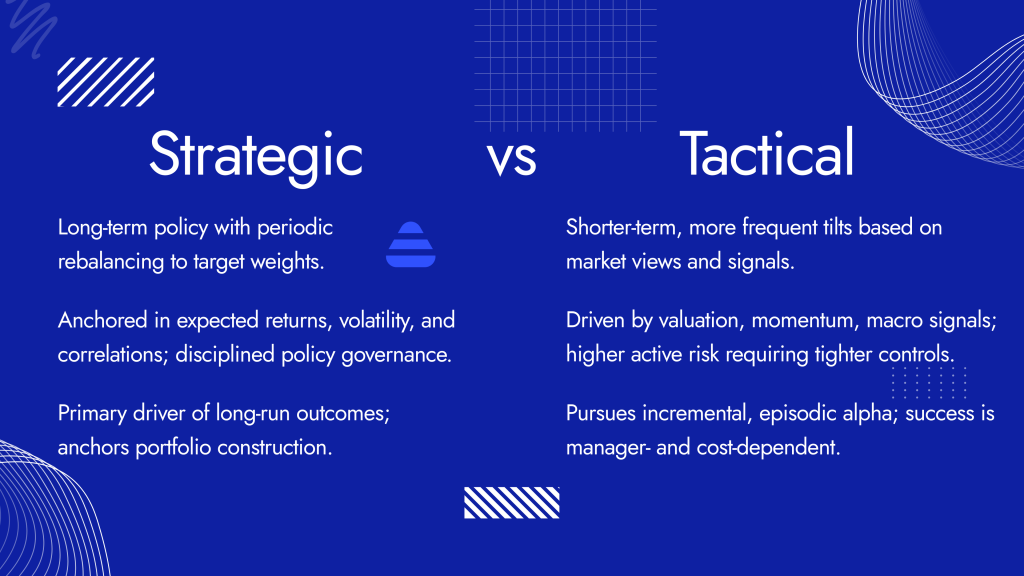
Strategic asset allocation (SAA) sets long-term weights aligned to goals and risk capacity, and rebalances to keep risk on track. This reduces the behavioural errors that come from chasing recent winners or timing macro cycles. SAA seeks to provide long-term growth for a set of investment objectives and is meant for investors with an investment horizon of 5+ years.
Tactical Asset Allocation
Tactical asset allocation (TAA) makes disciplined, temporary tilts around those targets using signals like valuation or momentum. TAA can add value episodically for skilled, process‑driven managers with strong risk controls and low costs (1). The premise of tactical asset allocation is to maintain focus on asset allocation first and securities selection second. TAA can adapt to markets faster reacting to developments at a faster pace.
Strategic vs Tactical Allocation
Risk Parity
Risk parity equalises risk contributions rather than dollars by reducing equity volatility and scaling up lower‑volatility assets (often with modest leverage), aiming for better diversification of risk and higher Sharpe per unit of total volatility. Implementation realism matters: funding costs, correlation shifts, and drawdown controls materially influence live outcomes relative to backtests and should be explicitly evaluated (5).
Life-Stage Based
Lifecycle strategies tilt more to equities early when human capital is higher and gradually increase bonds and cash as retirement nears to reduce sequence‑of‑returns risk (3). Target‑date “glidepaths” automate this de‑risking, but still benefit from diversified global exposures and periodic rebalancing to keep risk aligned with evolving goals and liabilities.
Real‑world performance comparisons
Understanding trade‑offs requires looking at multiple regimes, not a single cycle narrative, and judging allocations by total return, volatility, drawdowns, and path‑dependence. Long‑horizon stress tests of the 60/40 across 150 years show it has typically delivered balanced growth, but bond drawdowns and correlation shifts (like in 2022) created unusually equity‑like pain that warrants diversification beyond a single bond hedge assumption.
- Strategic vs tactical contribution: Empirical and practitioner evidence places SAA as the primary driver of long‑run outcomes; TAA’s contribution is manager‑ and process‑dependent, best implemented within tight bands and measured net of costs and taxes (2).
- Risk parity across regimes: By spreading risk across equities, bonds, and sometimes commodities, risk parity can lift risk‑adjusted returns and smooth drawdowns, particularly when equity beta dominates traditional mixes. However, leverage costs and correlation spikes can compress advantages, making realistic funding and volatility‑target assumptions crucial in evaluation (5).
- Lifecycle glidepaths with nuance: Glidepaths help align risk to horizon, but should reflect labor income cyclicality, funded status, and spending needs; modest inflation hedges and duration matching can reduce retirement sequence risk while retaining some growth for longevity (3).
See the comparison table for a quick overview.
Choosing an Asset Allocation Strategy
Start from objectives, horizon, and drawdown tolerance, then select a core approach (simple 60/40, risk‑based, or lifecycle) and decide whether to allow tactical bands. Define rebalancing rules, target tracking error, and validation methods (backtests, scenario analysis, benchmark comparisons) to ensure the policy aligns with real‑world risk capacity and behaviour under stress (3).
Evidence‑led testing beats intuition
Backtesting is not prediction, but it reveals how an asset allocation strategy might behave across macro shocks, helping set expectations for returns, volatility, and drawdowns before committing capital. Robust tests compare multiple allocations (60/40, risk parity, optimised, lifecycle), use consistent rebalancing logic, include costs, and examine multiple windows to avoid overfitting and single‑period bias (6).
Strategic Allocation
Strategic Asset Allocation is aimed to give the highest rate of return for a given level of risk. SAA proves to be critical in delivering on long term outcomes, but, needs to be implemented requires consideration of how much to allocate to active overlays which are done in conjuction (2).
Where Risk Parity Adds Value
Risk parity can improve diversification of risk and raise risk‑adjusted returns when leverage is prudently managed and financing costs are reasonable within policy constraints. Hybrid designs, risk parity cores supplemented with inflation‑sensitive assets, can stabilise outcomes across more macro regimes than equity‑dominant mixes (8).
Tactical Allocation
TAA has its positives with adaptability and the shorter time horizons providing room for market adjustments but, to be profitable with TAA requieres investors to be highly accurate on multiple factors. This includes market entry and exit times, position sizing, transaction fee controls and most importantly deciding on reliable indicators in rapidly evolving market. (2).
Life‑Stage Glidepaths Done Right
Beyond age, incorporate labor income risk, funded ratio, and spending needs into glidepath design; investors with equity‑like human capital can often sustain more early equity, while cyclical earners may favor smoother exposures. Near retirement, combine modest de‑risking with duration matching and optional inflation hedges to mitigate sequence risk while keeping some growth for longevity (3, 15).
How Diversiview Helps Your Asset Allocation
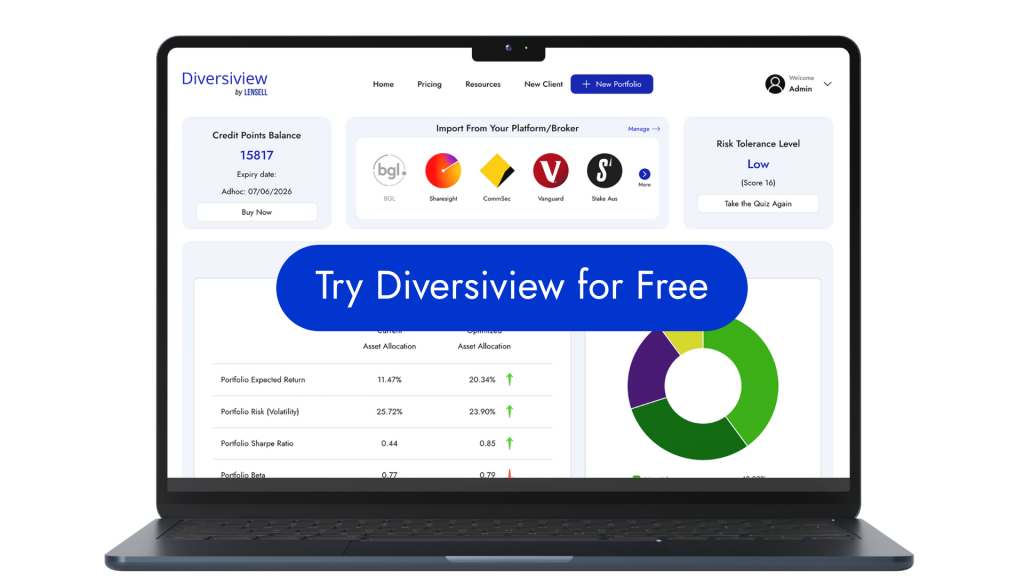
Diversiview’s advanced analytics make asset allocation strategy selection data‑driven by providing backtesting, optimisation, and risk diagnostics in one workflow that reduces estimation error and behavioural bias. Diversiview lets you compare current allocations against equal‑weight and optimised portfolios, visualise diversification and correlation, calculate risk‑adjusted metrics, and calculate Efficient Frontier positions.
How Diversiview helps test and customise these strategies
- Run Strategy Backtesting to compare current vs equal-weight vs optimised allocations against a chosen index; review value progression, volatility, Sharpe, and maximum drawdown to quantify trade-offs before re-allocation.
- Use Efficient Frontier Positions in Your Portfolio Universe to select either the Minimum Risk or Optimal Allocation; then inspect the Correlation Matrix/network to surface concentration clusters and validate improved diversification..
- Benchmark and monitor: Use Performance & Benchmark to track the portfolio vs index post-optimisation and to revisit when risk drifts.
Key takeaways: prioritise a robust strategic allocation, test risk-based variants like risk parity, and use analytics to validate choices under multiple regimes; then commit to a rebalancing discipline that keeps risk aligned as markets evolve.
The Round Up
The most durable edge for long‑term investors is a clear, evidence‑led asset allocation strategy, not stock‑picking heroics, because allocation governs risk and compounding across regimes. Try allocating smarter with data: backtest and compare 60/40, risk parity, strategic, and lifecycle variants side‑by‑side, then formalise rebalancing to stay the course through cycles using Diversiview’s research driven analytics.
Try allocating your assets smarter! Open a free Diversiview account and get one FREE Portfolio Analysis, and discover how data-driven technology can help you achieve your goals.

Note: Diversiview does not provide financial advice or recommendations. Investment Portfolio Analyses are intended to provide investors with data driven insights and information. You should do your own further research, or speak with a licenced professional before making changes to your investment portfolio.
- Vanguard: Strategic Asset Allocation
- First Sentier Investors: Strategic Asset Allocation
- Investopedia: Optimal Asset Allocation
- Morningstar: 60 40 Portfolio Stress Test
- AQR: Understanding Risk Parity
- Diversiview: Backtesting Asset Allocations
- Vanguard: Understanding Stock Bond Correlations
- AQR: Confronting the Twin Perils of Inflation and Deflation
- SSGA: Is it time to rethink the 60-40 portfolio
- BlackRock: 60 40 portfolios and alternatives
- Vanguard: Misconceptions about the 60 40 portfolio
- JP Morgan: The case for alternative investments
- CFA Institute: Future of the 60 40 allocation
- Vanguard: Tactical vs Strategic asset allocation
- Schwab: Retirement portfolio assets allocation by age