Electric vehicles (EVs) and autonomous driving technologies are no longer futuristic concepts. They are influencing the modern investor, creating opportunities for listed securities across the Hong Kong, US, and Australian stock exchanges.
Why EVs and Autonomous Driving Matter
EVs and autonomous driving technologies are no longer niche sectors. They represent a broader technological shift with profound economic and investment implications. Global EV sales are growing at double-digit rates, driven by government incentives, environmental regulations, and increasing consumer acceptance. Autonomous driving, including robo-taxis and advanced driver-assistance systems (ADAS), promises to reshape urban mobility, reduce accidents, and lower transportation costs.
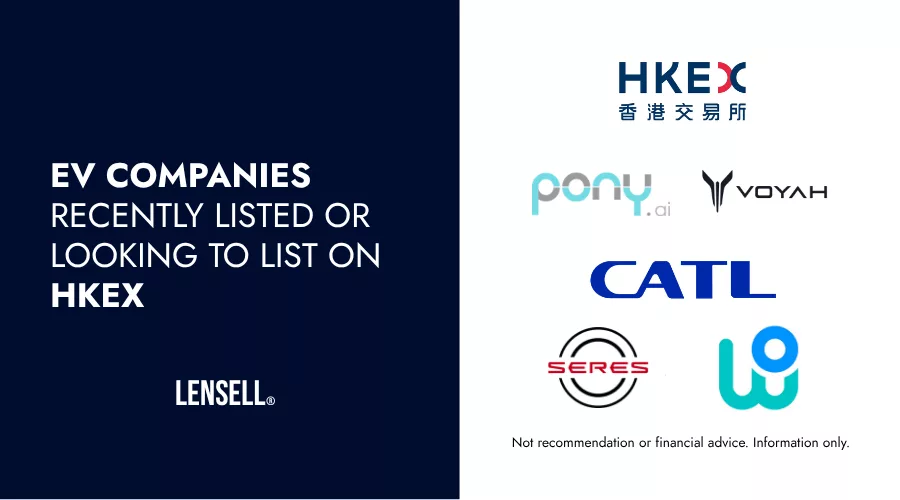
For investors, these trends create new equity opportunities. Companies in EV manufacturing, battery technology, AI-driven autonomy, and related supply chains are increasingly raising capital through IPOs and secondary listings. For example:
- Seres Group Co. Ltd (HKG: 9927), a Huawei-partnered EV manufacturer, completed an HK IPO in early November 2025, raising ~US$1.7–1.8 billion. (Reuters)
- Pony.ai Inc. launched its HK IPO process with pricing guidance up to HK$180/share, aiming to fund further development of autonomous driving solutions. (SCMP)
- WeRide Inc., a robotaxi firm, has filed for a Hong Kong IPO, with CEO lock-ups signaling long-term investor confidence. (WeRide)
- CATL, the world’s largest EV battery manufacturer, is pursuing a secondary listing on HKEX, one of the largest raises in recent years. (Financial Times)
- Dongfeng/Voyah is spinning off its EV unit for a separate listing, reflecting a trend of auto groups taking EV arms public. (WSJ)
These IPOs demonstrate the growing appetite of both retail and institutional investors for EV and autonomous driving plays.
Hong Kong Exchanges: Becoming a Hub for EV and Autonomy
Hong Kong’s stock exchange (HKEX) has emerged as a critical hub for tech-driven automotive listings. Regulatory frameworks now encourage dual listings and facilitate cross-border investment, making Hong Kong attractive for mainland Chinese companies. Secondary listings, such as CATL’s, allow companies to access international capital while retaining primary listings in China.
Hong Kong also offers liquidity and visibility for EV and autonomous driving startups that may not yet qualify for a US exchange IPO. The city’s investor base is sophisticated, with strong demand for technology and growth-oriented securities, making it an ideal location for IPOs like Seres and Pony.ai.
Comparing ASX, US Exchanges, and HKEX
The Australian Securities Exchange (ASX) has limited direct exposure to EV manufacturing and autonomous driving companies. Most Australian-listed companies in this area are technology providers, battery or mining companies supplying lithium, cobalt, or other key materials, such as Pilbara Minerals (ASX:PLS) or Orocobre Limited (ASX:ORE). While these companies benefit indirectly from the EV boom, the ASX does not yet host large-scale EV OEM or autonomous driving firms.
In contrast, US exchanges (NASDAQ, NYSE) host global leaders in EV and autonomous technologies, including Tesla (NASDAQ:TSLA), NIO Inc. (NYSE:NIO), and autonomous software developers like Aurora Innovation (NASDAQ:AUR). US exchanges provide deep liquidity, sophisticated derivatives markets, and access to global institutional investors.
HKEX sits somewhere in between. It offers access to China-based technology firms while also allowing global investor participation. The surge of IPOs in 2025, from EV manufacturers like Seres to robotaxi providers like WeRide, shows HKEX’s growing importance as a gateway for investors looking to tap into the EV and autonomy ecosystem.
Investment Opportunities and Risks
EV and autonomous driving equities are high-growth but high-volatility. Factors that influence performance include:
- Technology Development and Adoption – Companies can differentiate themselves by investing in battery efficiency, AI algorithms, and autonomous software.
- Government Policy – Subsidies, emission standards, and safety regulations significantly impact EV and autonomous adoption rates.
- Market Sentiment – IPO pricing, secondary listings, and cross-border capital flows can drive short-term volatility.
- Supply Chain Dynamics – Battery raw material prices, semiconductor availability, and logistics play a critical role and therefore can pose serious risks.
For investors, a diversified approach may be prudent. This could include investing across OEMs, battery manufacturers, autonomous software companies, and supporting technologies.
Future Outlook
The EV and autonomous driving sectors are poised for continued growth. Analysts predict that EV penetration in global light vehicles could exceed 30% by 2030, and autonomous technologies could account for a substantial share of urban transportation. For listed equities, this translates into:
- Increased IPO activity on HKEX and US exchanges.
- Expansion of secondary markets, ETFs, and derivative products targeting EV and autonomous sectors.
- Opportunities for cross-border investment flows, particularly from Asia to the US and Hong Kong.
The contrast with ASX-listed companies underscores the importance of geographic and thematic diversification. Investors looking to capture growth in EVs and autonomous technologies will need to balance exposure across different markets, themes, and stages of company maturity.
Conclusion
The rise of EVs and autonomous driving is not just a technological revolution; it is reshaping global capital markets. Hong Kong has positioned itself as a prime venue for companies to list, raising substantial capital while accessing international investors. Compared with the ASX and US exchanges, HKEX provides unique exposure to mainland Chinese EV and autonomy firms, while US exchanges remain the home of global technology leaders.
For investors, the message is clear: EV and autonomous driving equities are no longer niche plays—they are core components of growth-oriented portfolios. By understanding the market dynamics across exchanges and diversifying across OEMs, battery manufacturers, and autonomous software providers, investors can position themselves to benefit from one of the most transformative trends in mobility and technology today.
Sources: